Celia’s concealment of the call record to protect Henry
All the Old KnivesCelia Favreau’s concealment of the call record to protect Henry is an act of deliberate uncertainty: she hides evidence linking a call from Bill Compton’s phone to Jordan not because she can prove Henry innocent, but because she wants that possibility to remain open. Years later, her admission to Bill exposes how that choice protected Henry, left the truth unresolved, and became entangled with Henry’s attempt to use the same evidence against others.
The call and the concealed record
The concealed evidence is specific: a call from Bill Compton’s phone to Jordan on the first evening. When Bill asks whether Celia Favreau requested the embassy phone logs, she initially answers his question with another question. Bill explains that Henry Pelham told him she had asked for the records and that the call appeared in them. Celia confirms that she did request the logs. Bill then asks whether she covered up the call, and she confirms that too. The exchange distinguishes two acts: seeking the record and then suppressing what it showed. The text does not specify how Celia concealed it, or whether she altered, destroyed, or withheld a particular document; what it establishes is her admission that she buried the call.
The identity of the person at the other end remains uncertain in Celia’s account. In explaining her decision, she says that perhaps Henry was innocent and perhaps the Russian speaker on the other end was not Ilyas Shishani. She does not claim to have established either possibility. The call’s significance therefore rests not on a solved identification but on the gap between what the record could suggest and what Celia felt able to conclude from it.
Celia’s rationale
Celia describes the concealment as an attempt to protect Henry. After the people involved were killed, she could not say exactly what she thought. She entertained the possibility that Henry had not been in contact with Shishani, even while acknowledging that she did not truly believe the alternative explanation. What mattered was that she wanted to believe it. Her choice arises from that uncertain hope rather than from exonerating proof.
The deaths also shape her judgment of what disclosure could accomplish. Celia reasoned that bringing Henry before a tribunal would not bring the dead back to life. She therefore buried the call instead of turning it into a formal accusation. Henry answers that they no longer hold tribunals, but Celia’s recollection makes clear that the decision she describes belonged to the earlier moment, when she chose concealment in the aftermath of the killings. Her reasoning does not erase the evidence; it sets the evidence aside because she sees no restorative outcome in pursuing it.
Exposure and confrontation
The admission unfolds in a tense exchange with Bill. He asks whether Celia covered up the call, and she answers yes; when he asks why, she explains that she wanted to protect Henry. The directness of those brief answers contrasts with the complicated uncertainty behind them. Bill’s questions establish that Henry has already told him about the phone logs, so Celia’s secret is no longer only a matter between her and the evidence: it has entered a confrontation shaped by Henry’s account of it.
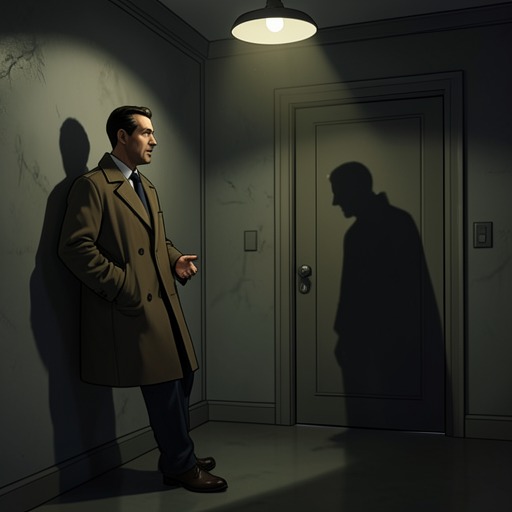
Later, as Henry faces Celia, her attention is fixed past him toward the front door. Her arms are folded across her stomach, and her eyes are wet when she turns back to him. In that moment she explains that she buried the call from Bill’s phone to protect Henry, because the people who might have been brought into the inquiry were already dead and she could not be certain who had spoken on the line. The scene makes the earlier concealment a personal confession as well as a disclosure about records: Celia names what she did and the uncertainty that governed it.
Henry’s reuse of the evidence
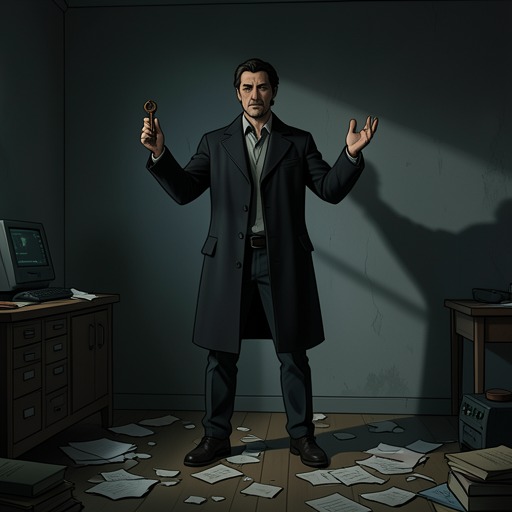
Celia’s account also reverses the meaning of Henry’s renewed attention to the call. She says that he selected this one piece of evidence and used it to frighten Bill. In her interpretation, Henry thought that making a call from Bill’s line would frame Bill, or possibly Celia. She wagers that Henry did not understand that pressing the issue would expose him instead. The account presents this as Celia’s reading of Henry’s conduct, not as independent proof of exactly what he intended.
The call thus returns in altered form. Celia had suppressed it to shield Henry from suspicion; Henry later brings it forward as leverage against Bill, and Celia argues that his effort to wield it turns suspicion back toward himself. When Henry dismisses the prospect of being hanged, Celia smiles and suggests that his confidence may be self-deception. The concealment never resolves who made the call or who was on its other end. Instead, it binds Celia’s act of protection to Henry’s later exposure, showing how evidence withheld to prevent a reckoning can reappear as an instrument in another struggle over blame.